
Banner Size Cheat Sheet: From Sidewalks to Stadiums
Printing vinyl banners or indoor banners may seem like an easy task, from choosing a size, adding a design, and checking out to waiting for your order and finally having it on display — but it won't be as effective if it's too small to read a single word or too big that it looks overwhelming
Whether you're displaying them on sidewalks, storefronts, trade shows, or stadiums, the right banner size can determine your banner's visibility, readability, and the way your message will be received by your target audience. So, how do you choose which banner size you need? Read on as eSigns shares a quick cheat sheet to help you pick the right banner size, avoid common mistakes, and get the most impact on your banner.

Why Banner Size Matters

Banners are not just designed to take up space. Here are some reasons why choosing the right banner size is important:
Visibility and Readability
Banner size determines how visible or easy it is to read your message. If you’re displaying a small banner in a large venue, your audience will have difficulty understanding its content. On the other hand, large banners displayed in a small area might be too overwhelming, obstructing views, and causing inconvenience to people or establishments.
Cost vs. Impact
Large banners are typically more expensive because they require more material, ink, and, in some cases, installation services. Bigger banners don’t necessarily mean better — what’s important is that your banner gets the most impact without any wasted space or additional printing costs.
First Impressions Matter
A banner reflects your brand’s first impression. If it’s too small, it gives off an unprofessional, amateur vibe, while a large, poorly designed banner can look rushed, unpolished, and unplanned.
The Rule of Thumb: Viewing Distance
Before picking a banner size, know where your audience will be. For sidewalk banners, people can just be a few feet away. However, in larger venues, your audience can be hundreds of feet away.
A simple rule of thumb for readability:
1 inch of letter height for every 10 ft. of viewing distance
For example, if your banner is 50 ft. away, the letter height of your text should be at least 5 inches. If your banner is 100 ft. away, then your text should be at least 10 inches tall. With this rule of thumb, you can ensure that both the text size and the overall banner dimensions are correct.
Remember to keep your message short, the farther your banner is. A simple bold word like “SALE” is more effective than seeing a full block of text talking about your sale.
Standard Banner Sizes
If you’re not sure which banner size to go for, here’s a standard banner size chart that you can use as a starting point:
| Banner Location | Typical Sizes | Viewing Distance | Best Use |
|---|---|---|---|
| Sidewalk / Street-Level |
2' x 4' 3' x 5' 3' x 6' |
5 - 20 ft. | Foot traffic, small local promotions, store windows |
| Shopfront / Retail Windows |
3' x 6' 4' x 8' |
10 - 25 ft. | Attract street viewers, seasonal sales, small storefronts |
| Trade Shows / Booth Backdrops |
4' x 6' 4' x 8' 5' x 10' |
20 - 60 ft. | Booth walls, indoor events, conventions |
| Auditoriums / Gyms / Halls |
5' x 10' 6' x 12' |
30 - 80 ft. | School events, gyms, community halls |
| Stadiums / Arenas |
10' x 20' 15' x 30' 20' x 50' |
60 - 300+ ft. | Sports arenas, concert venues, |
| Building Wraps / Fences | Custom, often very large | 100 - 500+ ft. | Construction sites, billboards, outdoor advertising |
Small Banners (Close-Up Viewing)
Small banners are recommended for nearby foot traffic that requires close-up viewing. When choosing this size, keep your design bold and simple, so your banner stands out.
- Sizes: 2' x 4', 3' x 5', 3' x 6'
- Viewing distance: 5 - 20 ft.
- Best for sidewalks, shopfronts, small events, and indoor promotions.
Medium Banners (Mid-Range Viewing)
Medium banners are small enough for indoor spaces, but also large and easy to read from afar. For this banner size, use strong contrast, readable fonts, and keep your text minimal.
- Sizes: 4’ x 6,’ 4’ x 8’, 5’ x 10’
- Viewing distance: 20 - 60 ft.
- Great for trade shows, gym walls, auditoriums, and events.
Large Banners (Long-Distance Viewing)
Large banners are often used for long-distance viewing. They are usually made of durable materials and sometimes need professional installation due to their size. When using large banners, ensure that messages are concise, text is large, and images are simple yet eye-catching.
- Sizes: 8’ x 16’, 10’ x 20’, custom oversized formats
- Viewing distance: 60 – 300+ ft.
- Ideal for stadiums, building facades, and busy outdoor spaces.
Banner Sizes by Location
Sidewalk and Street-Level Banners
Sidewalk and street-level banners are designed to grab attention up close, especially in high-traffic areas. These banners are often placed outside storefronts, along fences, or near entrances for promotions or announcements. Keep in mind that some cities or municipalities have different regulations about the size and placement of outdoor banners. Check with your local government or ask around your community to avoid any violations or fines.
Common Sizes
• 3’ x 5’
• 3’ x 6’
Shopfront and Retail Banners
These banners can be read from across a room without overwhelming the space. They are versatile and are often used for branding and directional purposes. When displaying them on windows, choose smaller sizes. On the other hand, you might need larger wall banner sizes for greater visibility.
Common Sizes
• 3’ x 6’
• 4’ x 8’
Trade Show Banners
These banners are viewed from a distance, and are all about impact, not detail. While some trade show banners serve as backdrops, some are also used to showcase products and draw attention to booths. Trade shows have limited space and viewing distance, so it’s best to choose medium banners, which offer the perfect balance of size and readability.
Common Sizes
• 4' x 6'
• 4' x 8'
• 5' x 10'
Gym, School, and Community Hall Banners
School banners can either be displayed indoors or outdoors. They are commonly used to welcome students to a new school year, recognize sponsors, announce events, or show school spirit. When displaying in these venues, pick wall-mounted banners for smaller areas and hang banners for open spaces.
Common Sizes
• 5' x 10'
• 6' x 12'
Stadium, Arena, and Large-Venue Banners
These banners are displayed in areas where audiences are hundreds of feet away, such as concert venues, sports arenas, and outdoor events. Since these banners are printed in large sizes, professional installation is recommended to ensure that they’re mounted securely.
Common Sizes
• 10' x 20'
• 15' x 30'
• 20' x 50'
Building Wraps and High-Traffic Outdoor Banners
Banners of this scale are designed to be custom and extra large. These are often used for a wide variety of applications, like construction sites, fences, billboards, and building facades. For this type of banner, durable materials, reinforced edges, and wind slits are essential to protect against damage from outdoor conditions.
How Material and Mounting Affect Banner Size
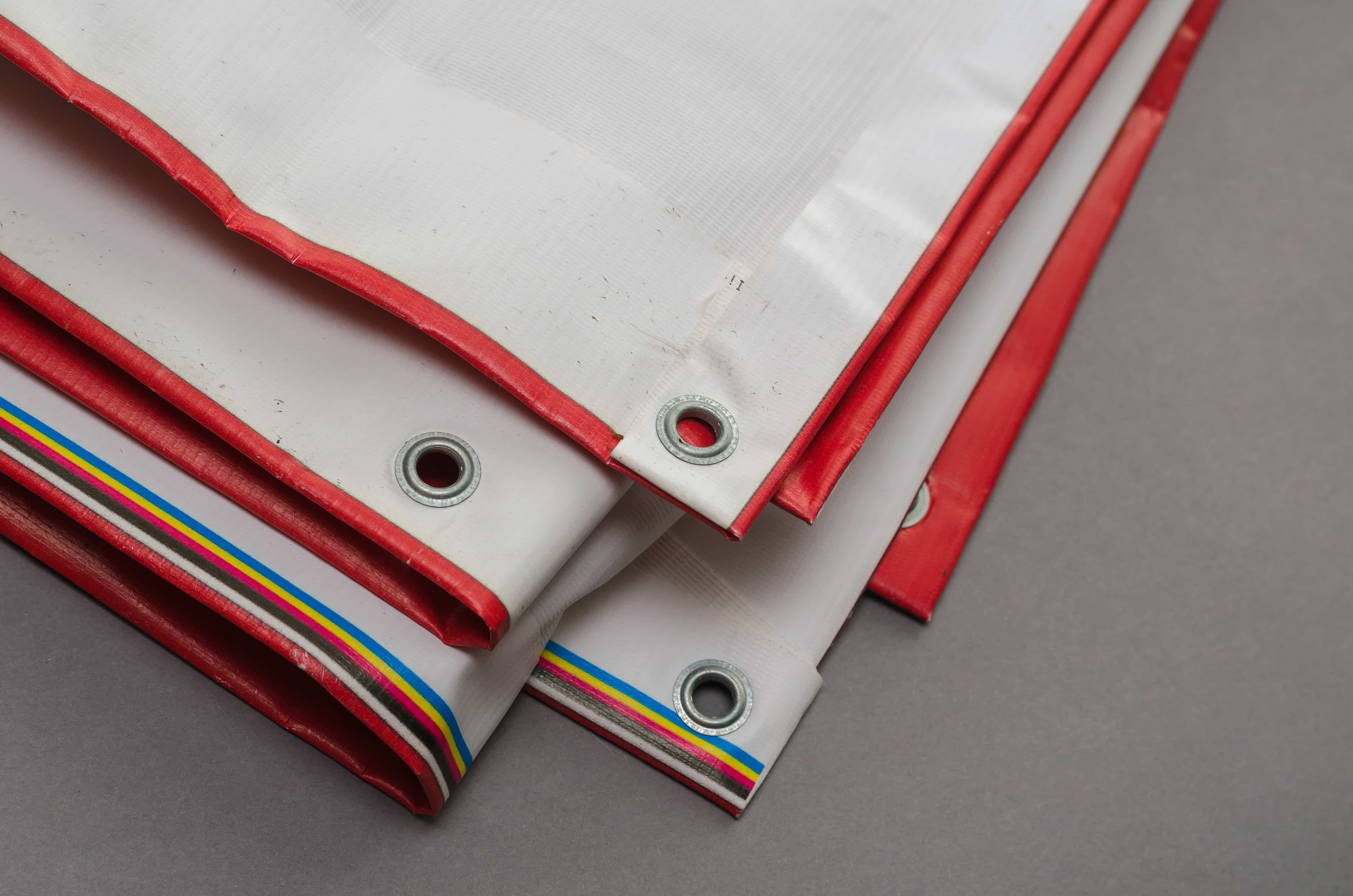
Banner size and material are two important factors to consider when printing banners. If you’re displaying larger banners, you need durable materials and better mounting that can withstand harsh weather conditions while keeping the banner secure and looking good.
Material
• Vinyl – Durable, weather-resistant, and suitable for both indoor and outdoor use.
• Fabric – Lightweight, glare-free, and wrinkle-resistant, best for indoor events and trade shows.
• Mesh – Features small holes that allow wind to pass through, recommended for outdoor displays.
Mounting Options
• Grommets – Choose for flexibility and displaying on fences or railings
• Pole pockets – Best for clean edges and lamp posts
• Rope or cable attachments – Suitable for hanging larger banners in buildings, stadiums, arenas, and other big venues.
Longevity Tips
• Keep banners taut or weighted to avoid flapping.
• Use wind slits and reinforced edges to reduce strain.
• Place the sidewalk or street banners at eye-level to instantly capture attention.
• Choose materials like fabric or heavy-duty vinyl to make the banner reusable for various events.
Design Tips That Scale With Size
Thinking of designing your banner? Follow these tips to make your banner effective:
• Choose bold, simple fonts. Don’t forget the rule of thumb for letter height is 1 inch for every 10 ft. of viewing distance.
• Use strong color contrast so that your text stands out and won’t get washed out in the background.
• Leave enough white space to avoid design clutter.
• Use a high resolution of 300 dpi to avoid pixelation and keep images sharp and clear.
• Design should support readability. Keep messages simple, bold, and concise. Do not include long paragraphs or excessive details to avoid overwhelming readers.
Common Banner Mistakes
Even well-designed banners can fall flat if you choose the wrong banner size. Below are some common banner mistakes:
• Choosing a size based on price alone
• Ignoring viewing distance
• Using small text on large banners
• Including too much text in the design
• Forgetting to plan for installation
Quick Banner Size Cheat Sheet
This cheat sheet sums up banner sizing rules at a glance:
- Viewing Distance
- Small banners - 5 - 20 ft.
- Medium banners – 20 – 60 ft.
- Large banners – 60 – 300+ ft.
- Banner Size by Location
- Sidewalks and storefronts – 3’ x 5’, 3’ x 6’, 4’ x 8’
- Trade shows – 4' x 6', 4' x 8', 5' x 10'
- Gyms, schools, and community halls – 5' x 10', 6' x 12
- Stadiums and outdoor spaces – 10' x 20', 15' x 30', 20' x 50', or custom sizes
- Text Size Rule
- 1 inch = 10 ft. of viewing distance
- Fewer words = Better readability for larger banners
- Indoor and Outdoor Use
Indoor – Fabric, vinyl, lighter materials
Outdoor – Vinyl mesh, reinforced edges, wind slits
How to Choose the Right Size Every Time
1. Find out where viewers will stand when they see your banner
2. Check the viewing distance.
3. Select a banner size based on the distance and location.
4. Choose between vertical and horizontal formats. Vertical banners are ideal for narrow spaces, while horizontal banners are best for wide facades.
5. Prioritize clarity and readability when designing banners.
6. When in doubt, opt for larger banners, especially when displaying outdoors
When choosing a banner size, remember always to consider the location, viewing distance, and purpose. This way, it becomes readable, visible, more effective, and memorable. We hope you can use this guide as a reliable starting point before placing an order for a banner that best fits your space and needs
Data Subject Rights

Privacy Request
You may have certain rights with respect to the personal information we collect and process. These rights vary by state and country and depend on your residency. These rights are not absolute and we reserve all of our rights available to us at law in this regard. Please complete the below form to exercise one of your data subject rights, where applicable. We will process your request within the time provided by applicable law.